
Building an AI Growth Flywheel creates a powerful competitive advantage for modern businesses. This AI Growth Flywheel uses customer data to train custom models. As your AI improves, your product delivers better results. Better results attract more customers to your business. More customers generate richer data streams automatically. This continuous cycle forms the ultimate data-to-growth loop. In this guide, you will learn how to build this engine step by step.
Table of Contents
- How the AI Growth Flywheel Powers Business Scale
- Building the Data-to-Growth Loop Infrastructure
- Connecting CRM Data to Custom AI Models
- Measuring Product Quality and Customer Retention
- Automating Data Capture Across Every Touchpoint
- What Can You Actually Do? A Step-by-Step Plan
- Summary and Next Steps
1. How the AI Growth Flywheel Powers Business Scale
Traditional growth strategies rely on constant ad spend. When ad budgets stop, customer acquisition freezes immediately. An AI Growth Flywheel solves this fundamental business challenge. It creates a self-reinforcing cycle driven by real usage data.
Each customer interaction fuels your AI Growth Flywheel naturally. Every form submission, support chat, and booked appointment provides valuable training data. As your system collects more data, your AI models learn faster. Better AI accuracy means your customers get faster, smarter service.
Research from the McKinsey Global AI Survey shows that companies using data-driven AI report 20% higher earnings growth. High-performing organizations capture customer feedback at every journey stage. They feed this feedback directly back into their product workflows. Understanding how AI is transforming businesses helps you build this advantage early.
2. Building the Data-to-Growth Loop Infrastructure
A successful growth loop requires structured data collection. Disconnected tools create data silos that stall your momentum. When customer interactions stay trapped in separate apps, your AI cannot learn.
A well-designed AI Growth Flywheel unifies your entire tech stack. It connects website forms, CRM records, and messaging channels into one central repository. Clean data pipelines allow custom AI models to process real buyer signals smoothly.
According to research from PwC Global, business automation can boost labor productivity by up to 40%. Centralizing customer data reduces manual cleanup time significantly. Your team spends less time fixing errors and more time serving clients.
3. Connecting CRM Data to Custom AI Models
Your sales and support records contain goldmines of customer intent. When you connect operational data to AI models, magic happens. Your system begins predicting client needs before problems arise.
Using a unified CRM with calendar booking simplifies lead tracking. Automatic time zone detection prevents scheduling errors during consultations. When prospective clients book appointments, their preferences enter your database instantly.

Connecting your CRM accelerates the AI Growth Flywheel feedback loop. For example, our 24/7 AI Receptionist records call inquiries, web chat messages, and review feedback. You can explore this architecture in our lead to legacy AI agent architecture guide. This data helps your team refine response accuracy continuously.
4. Measuring Product Quality and Customer Retention
Product improvement must lead directly to higher customer retention. When buyers receive fast, personalized experiences, they stay longer. Loyal clients generate higher lifetime value and refer new prospects.
Data from the Salesforce State of the Connected Customer Report reveals that 88% of buyers say customer experience is as important as product quality. Tracking retention metrics proves that your AI models are working effectively.
Analyzing data streams keeps your AI Growth Flywheel moving smoothly. You can evaluate the financial impact using our AI ROI calculator framework. You track cost savings alongside revenue gains. Clear analytics demonstrate real business impact to leadership and investors.
5. Automating Data Capture Across Every Touchpoint
Manual data entry slows down growing companies. Human reps forget to log calls or update deal stages during busy workdays. Automated data capture eliminates this friction completely.
A centralized Marketing Operating System automates outreach across email, SMS, and voice. Built-in integrations simplify payment tracking for invoices, contracts, subscriptions, and product sales via our payments tools. The system covers GDPR, CAN-SPAM, and PCI DSS compliance automatically.
Automation tools feed your AI Growth Flywheel with accurate customer signals. Every transaction and message enriches your client profiles. Your business stays responsive 24/7 without adding expensive staffing overhead.
6. What Can You Actually Do? A Step-by-Step Plan
Building a self-sustaining growth loop requires a clear execution plan. Follow these four practical steps to launch your system today.
Step 1: Activate Your AI Growth Flywheel
First, audit your existing customer touchpoints. Identify where client interactions occur daily. Map out your website forms, inbound phone calls, support chats, and appointment schedulers.
Step 2: Connect Your Customer Touchpoints
Next, consolidate your software applications into one platform. Eliminate disconnected single-purpose tools. Centralizing customer records ensures your database stays accurate and up to date.
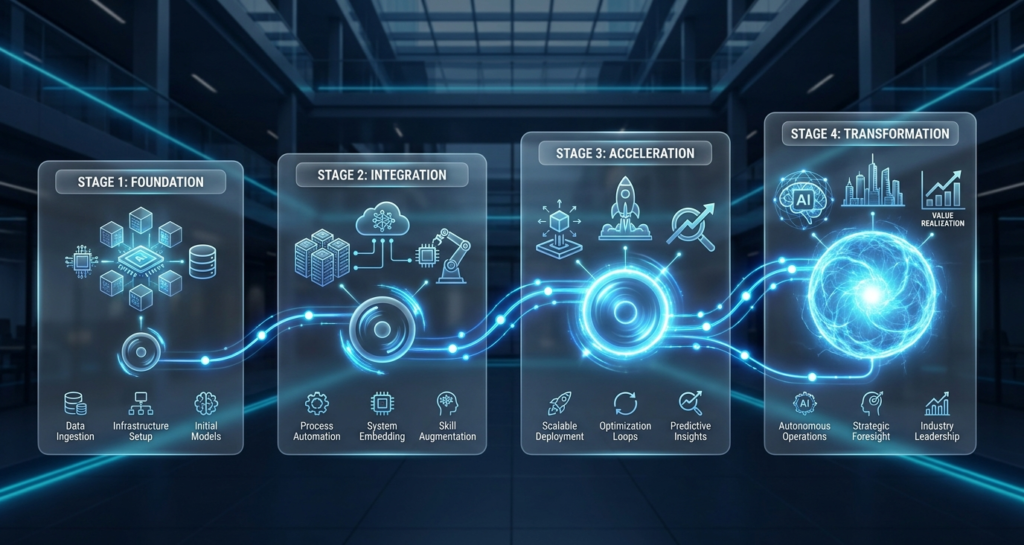
Step 3: Train Custom AI Automation Workflows
Deploy automated tools like virtual receptionists and instant text-backs. Use incoming conversation logs to refine messaging templates. If you need dedicated execution support, explore our DMDepartment marketing hub.
Step 4: Monitor and Refine Your Growth Metrics
Finally, review your conversion rates and customer satisfaction scores weekly. Consistent data ingestion protects your AI Growth Flywheel from stalling. Adjust automated workflows based on real buyer behavior.
7. Summary and Next Steps
Relying solely on paid ads limits your business growth. Adopting an AI Growth
Flywheel transforms how your business scales operations. You turn daily customer interactions into a sustainable competitive advantage. Your product improves continuously while acquisition costs drop over time. Visit our blog page for more growth strategies. You can also visit our home page to explore our platform features.
Ready to build your custom growth engine?
👉 Start your free 30-day trial with MyDMDesk today!
To your success,
The MyDMDesk Team
Sources
- McKinsey Global AI Survey: https://www.mckinsey.com/capabilities/quantumblack/our-insights/the-state-of-ai
- PwC Global AI Study: https://www.pwc.com/gx/en/issues/data-and-analytics/publications/artificial-intelligence-study.html
- Salesforce State of the Connected Customer Report: https://www.salesforce.com/resources/research-reports/state-of-the-connected-customer/