

“You don’t need a full-time AI executive to make executive-level AI decisions — you need someone with the authority to make them, on whatever schedule your business can actually afford.”
Key Takeaways
- The Golden Nugget: A fractional AI leader gives you the same strategic ownership as a full-time Chief AI Officer — roadmap, governance, vendor decisions, board reporting — for roughly a fifth to a third of the cost, without a six-to-nine-month executive search.
- The How-To Hint: The engagement works best when it’s scoped around a small number of specific, measurable use cases, not an open-ended mandate to “figure out AI” for the whole company.
- The So-What Factor: The businesses winning this shift aren’t the ones with the biggest AI budget — they’re the ones who found someone accountable for AI decisions months before their competitors did.
Overview: The Big Picture
For the last two years, most small and mid-sized businesses have approached AI the same way: a founder tries ChatGPT, a manager runs a pilot automation, someone on the team quietly starts using an AI tool nobody signed off on. What’s usually missing isn’t enthusiasm or even budget — it’s a single person accountable for turning scattered experiments into a coherent strategy. Historically, the answer to “we need senior leadership but can’t afford a full-time hire” has been the fractional executive — a model long proven in finance (the fractional CFO) and marketing (the fractional CMO).
The Fractional AI Strategy simply applies that same logic to artificial intelligence: bring in a senior AI executive part-time, give them real authority over strategy and governance, and let them build the roadmap a full-time hire would otherwise spend their first six months discovering.
This isn’t a theoretical trend. Adoption of dedicated AI leadership has moved faster than almost any other executive role in recent memory, and the fractional version of that role exists specifically to close the gap between companies that know they need AI leadership and companies that can’t yet justify — or can’t even fill — a permanent seat for it.
The Analogy: Putting it into Perspective
Think about how most homeowners handle electrical work. You don’t hire a full-time, in-house electrician to live on your payroll — that would be absurd for the amount of actual electrical work your house generates in a given month. But you also don’t let an untrained neighbor rewire your breaker panel because it’s cheaper than calling a professional. You hire a licensed electrician for the hours the job actually requires, and you trust their judgment completely while they’re on the clock. The Fractional AI Strategy applies that exact same logic to artificial intelligence: you don’t need AI expertise living in your building forty hours a week, but you absolutely need it to have real authority when it shows up.
The Core Framework: The Fractional Engagement Model
1. The Right Trigger
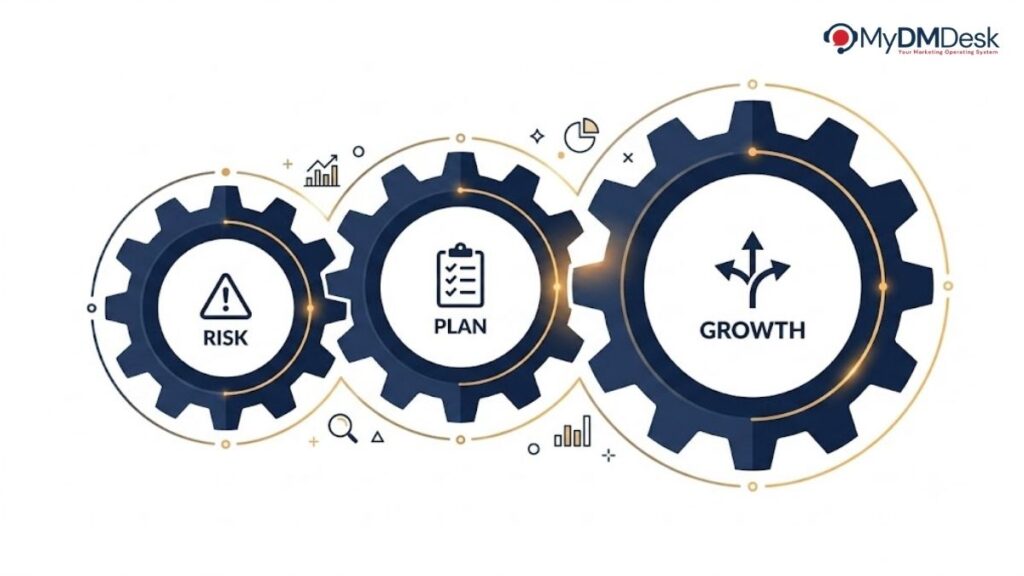
Not every business needs a fractional AI leader today, and recognizing the right moment matters more than rushing in. The clearest signals are a board or leadership team that can’t yet articulate a one-paragraph AI strategy, “shadow AI” spreading across departments with no governance behind it, and a budget that’s been approved for AI investment with no clear direction for where it should go. If your organization has AI pilots that keep stalling before they reach production, that’s usually not a technology problem — it’s an ownership problem.
2. The Engagement
A well-structured fractional engagement isn’t a vague advisory retainer — it’s scoped, accountable, and time-boxed. The fractional leader typically works one to three days a week, sits in real leadership meetings rather than delivering slide decks from the outside, and focuses on two or three specific use cases with a defined 90-day path to a measurable result. Their responsibilities mirror a full-time Chief AI Officer almost exactly: setting the roadmap, making build-versus-buy calls, establishing governance and data-risk policy, and reporting progress to the board — just compressed into a part-time cadence instead of a full-time one.
3. The Transition
This is the part most companies overlook, and it’s the part that separates a well-run fractional engagement from an expensive, open-ended dependency. The purpose of fractional AI leadership isn’t to exist forever — it’s to build the conditions under which it’s no longer needed. A good engagement ends in one of two ways: the organization has enough clarity and internal capability to either hire the right full-time leader from a position of evidence, or to absorb ongoing AI governance into an existing executive’s role. If a fractional engagement never has an exit conversation, that’s usually a sign it’s being run as a subscription, not a strategy.
Evidence in Action: Data & Real-World Examples
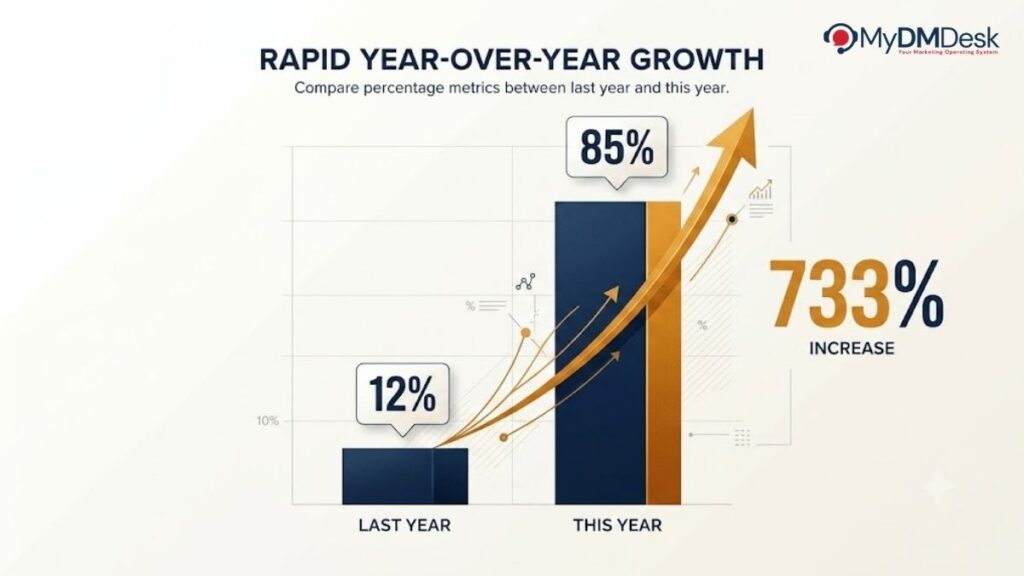
The Statistic: <cite index=”34-1″>IBM’s 2026 CEO Study found that 76% of organizations now have a Chief AI Officer, up from just 26% a year earlier</cite> — one of the fastest executive-role adoption curves in recent memory. The catch is that most of that growth is concentrated in large enterprises that can absorb a $300,000-plus salary. For everyone else, the economics tell a different story: <cite index=”36-1″>a fractional CAIO engagement typically represents $60,000 to $180,000 annually, compared to $300,000 to $550,000 for a full-time hire at a mid-market company</cite>. That gap — real demand for AI leadership colliding with a price tag most smaller businesses can’t justify — is exactly the space the fractional model was built to fill.
The Case Study: One of the clearest illustrations of the model working in practice comes from operators building entire businesses around it. John Cheney’s General AI Proficiency Institute took the fractional Chief AI Officer model and applied it deliberately outside the tech industry — working with construction firms, law firms, dental groups, and staffing companies, industries where “AI strategy” was previously nobody’s job. The pattern that made it work wasn’t industry expertise; it was structure: a fixed monthly retainer, a seat in real leadership meetings, and accountability for a specific, board-visible outcome within six months. It’s a useful proof point precisely because it shows the model scaling across completely unrelated business types — the mechanism, not the vertical, is what drives the result.

The Deeper Truth: Strategic Synthesis
The Shift: The mindset change required here is treating AI leadership as an accountability problem before it’s a technology problem. Most companies buy tools first and ask “who owns this?” second — the fractional model forces you to answer the ownership question before you spend another dollar on software
The Common Pitfall: Businesses hire a fractional AI leader and then treat the relationship like a consulting subscription — monthly calls, occasional recommendations, no real authority to change how the business actually operates. The model only works when the leadership team is genuinely willing to act on what the fractional executive recommends. Without that willingness, you’re paying for a document-production exercise, not a strategy.
The Competitive Advantage: The payoff isn’t just cost savings — it’s speed. A fractional leader arrives with pattern recognition from having solved the same problem at other companies, which means they can often identify your first validated use case in weeks instead of the months a first-time, single-company hire would spend discovering it. In a landscape where AI capability compounds quarter over quarter, that head start is the actual advantage — the lower price tag is just what makes it accessible.
How to Get Started: The Tactical Guide
- Immediate Action: In the next ten minutes, write down the single AI question your board or leadership team gets asked most often that nobody can currently answer with confidence. That question is your starting scope — not “AI strategy” in the abstract.
- Strategic Alignment: Before you contact a single candidate, agree internally on decision rights — who signs off on what the fractional leader recommends, and what authority they’ll actually have in the room. A fractional leader without real authority becomes an expensive advisor nobody listens to.
- Measurement: Set a 90-day checkpoint from day one, with a specific, board-visible outcome attached to it — a saved hire, a cut cycle time, a new revenue line, a governance policy in place. If a fractional engagement can’t point to a concrete result at 90 days, that’s the signal to reassess, not extend.
Final Thoughts
The Fractional AI Strategy isn’t a workaround for companies that can’t afford a “real” AI leader — it’s often the more disciplined path, because it forces accountability and measurable outcomes from day one instead of assuming they’ll emerge once a permanent hire settles in. The businesses pulling ahead right now aren’t the ones with the biggest AI budget — they’re the ones who put someone in charge of the decision months before their competitors did.