

“In 2024, we learned to talk to AI. In 2026, we are learning how to let AI talk to itself. True scale isn’t found in a single chatbot; it’s found in an orchestra of agents.”
Key Takeaways
- Specialization over Generalization: Multi-agent systems move away from “one-size-fits-all” AI toward a team of specialized agents (Sales, SEO, Data, Ops).
- Autonomous Problem-Solving: By allowing agents to “orchestrate” among themselves, businesses can solve multi-step problems without human bottlenecks.
- The Managerial Shift: Your role is moving from “Doing the Work” to “Managing the Digital Workforce.”

Overview: The Big Picture
For the past two years, most businesses have treated AI like a high-end search engine or a solo assistant. You give a prompt, and you get an answer. But complex business problems—like launching a marketing campaign or managing a supply chain—are rarely solved with a single prompt.
Multi-Agent Orchestration is the trend of 2026 where specialized AI agents operate as a cohesive team. One agent researches the market, another drafts the copy, a third checks for brand compliance, and a “Leader Agent” orchestrates the entire flow. This isn’t just automation; it’s a digital department.
The Analogy: The General Contractor vs. The Handyman
A single AI is a Handyman. They are great for fixing a leak or painting a wall, but they can’t build a house alone. Multi-Agent Orchestration is the General Contractor. They hire the plumber, the electrician, and the framer, and ensure everyone is working off the same blueprint to deliver a finished home.
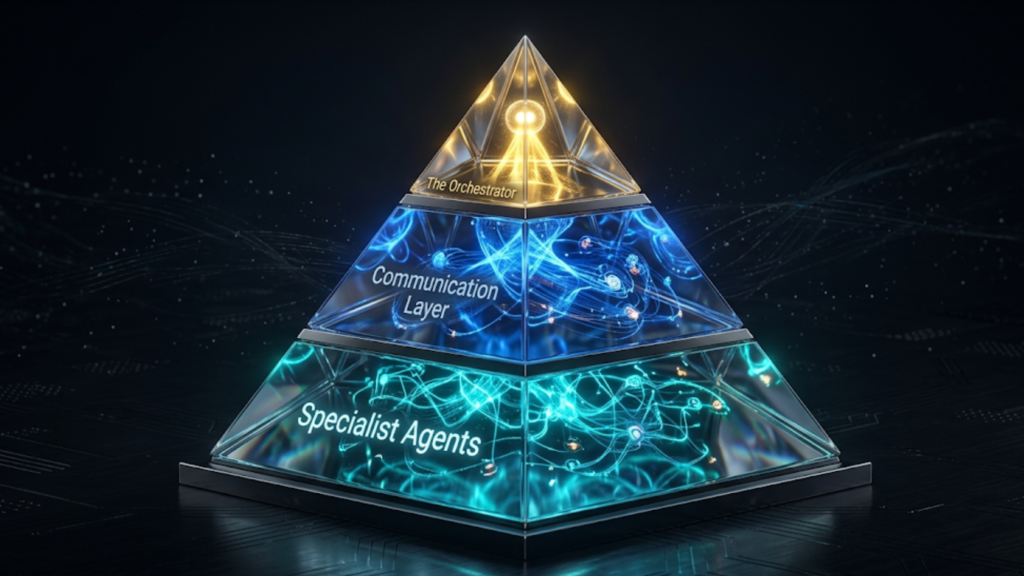
The Core Framework: The Orchestration Stack
To build a multi-agent system, your business must move beyond the “chat window” and into a structured architecture.
1. The Specialist Layer
This consists of “Small Language Models” or specialized GPTs tuned for specific tasks. A specialized agent will always outperform a general model in its niche.
2. The Communication Protocol
Agents need a shared “memory” and a way to pass data. This ensures the “SEO Agent” knows what the “Product Agent” just updated so the content stays accurate.
3. The Orchestrator (The “Brain”)
This is the master agent that evaluates the user’s goal, breaks it into tasks, assigns them to the specialists, and reviews the final output before you ever see it.

Evidence in Action: Data & Real-World Examples
The move toward orchestration is backed by significant shifts in enterprise efficiency.
- The Statistic: According to Gartner’s 2026 AI Roadmap, businesses utilizing multi-agent orchestration have seen a 35% reduction in operational latency and a 50% increase in task completion accuracy compared to single-agent workflows.
- The Case Study (Fintech): Leading firms are now using orchestration for loan processing. A “Data Agent” pulls the credit report, a “Fraud Agent” scans for anomalies, and a “Compliance Agent” checks local regulations. By talking to each other, they reduced approval times from 3 days to 4 minutes.

The Deeper Truth: The End of “Prompt Engineering”
We are moving away from the era where “knowing how to prompt” is a valuable skill.
- The Shift: In an orchestrated environment, agents prompt each other. Your only job is to define the Outcome.
- The Common Pitfall: Over-complicating the team. Adding ten agents to solve a two-agent problem creates “Digital Bureaucracy.” Start with two agents that talk well together.
- The Competitive Advantage: Companies with an orchestrated digital workforce can scale their output 10x without adding a single human head to the payroll.

How to Get Started: Building Your First Duo
You don’t need to build a 50-agent army today. You just need a duo.
- Identify a “Baton-Pass” Task: Find a process where a task is finished by one person and handed to another (e.g., Sales Lead → Email Nurture).
- Define the Hand-Off: Write down exactly what information the first agent needs to give the second agent to be successful.
- Deploy an Orchestrator: Use tools like CrewAI or Microsoft AutoGen to let those two agents start “discussing” the task autonomously.
Final Thoughts
The competitive gap in 2026 isn’t between those who use AI and those who don’t. It’s between those who have one AI assistant and those who have a self-managing digital team.
Stop prompting. Start orchestrating.